
Powering Healthcare Through the Outage: Mazzetti’s Approach to Long-Duration Energy Storage
Hospitals cannot afford critical systems to go offline. It does not matter if it is a wildfire, a heat wave, or a multi-day utility shutoff. Power, medical equipment, life safety systems, HVAC, communications, and other essential infrastructure all have to keep working, so patients stay safe. That has never been negotiable.
What has changed is how we get there.
For decades, the answer was diesel. Big tanks, loud generators, toxic exhaust, and just enough fuel to hold out until the grid came back. It worked, more or less. But it was never a good solution. It was just the only one we had.
That is starting to change, and Mazzetti has been part of that shift since before most people were paying attention.
Why Diesel Isn’t the Answer Anymore
California’s grid has had a rough few years. Wildfires and extreme heat have driven Public Safety Power Shutoff (PSPS) events that knock out power to entire regions for days at a time, and sometimes longer. During those events, the California Air Resources Board has documented nearly 125,000 additional generators running across the state, pumping out roughly 170 tons of NOx into the air. For communities already dealing with high pollution burdens, that’s not an acceptable trade-off.
There is also the NFPA 110 requirement that hospitals maintain enough fuel to run at full load for 48 hours. That is a meaningful commitment in space, logistics, cost, and emissions. And as PSPS events grow longer and more frequent, 48 hours is starting to feel like a floor, not a ceiling.
Long-duration energy storage (LDES) changes the equation. Instead of burning fuel to make it through the outage, a well-designed LDES system can island a facility, keeping it running on stored energy and renewables for 10 hours, 24 hours, or more. No diesel. No exhaust. No refueling trucks trying to navigate closed roads during a disaster.
The state’s own energy goals underscore the urgency. California will need more than 50 gigawatts of energy storage, including 4 GW of long-duration storage, to hit its 2045 clean energy targets. The CPUC has called for 15,000 megawatts of new storage and demand response resources by 2032. Healthcare facilities aren’t sitting on the sidelines of that transition. They’re squarely in the middle of it.
Mazzetti’s Work: From Research to Real Projects
Mazzetti didn’t arrive at this space by accident. The firm has been doing the hard engineering work, designing systems, writing code language, and pursuing grant funding for years.
The CEC Grant: Proving LDES in the Real World
Mazzetti pursued funding through the California Energy Commission’s EPIC (Electric Program Investment Charge) program, which focused on deploying LDES in underserved communities. The goal wasn’t just to build something. It was to prove that non-lithium-ion storage technologies could work at 24 hours or more of duration, in real-world settings, serving the communities that need resilience the most.
Those use cases, including microgrid resiliency, load management, firming for power purchase agreements, and energy market participation, are not abstract. For a hospital in a high fire-threat district that has been hit by three PSPS events in two years, they are operational priorities.
The LDES Technology Study
To support the grant application and sharpen the firm’s technical recommendations, Mazzetti engineers Gabriella Radina and Jasmine Thomas conducted an internal Chemical/Electrochemical Long-Duration Energy Storage Technology Study. The research dug into emerging battery chemistries, evaluating cost, reliability, flammability, recharge time, power density, and technology readiness, to give Mazzetti’s project teams a solid foundation for LDES recommendations in real healthcare environments.
Kaiser Permanente Ontario: The Project That Proved It Could Be Done
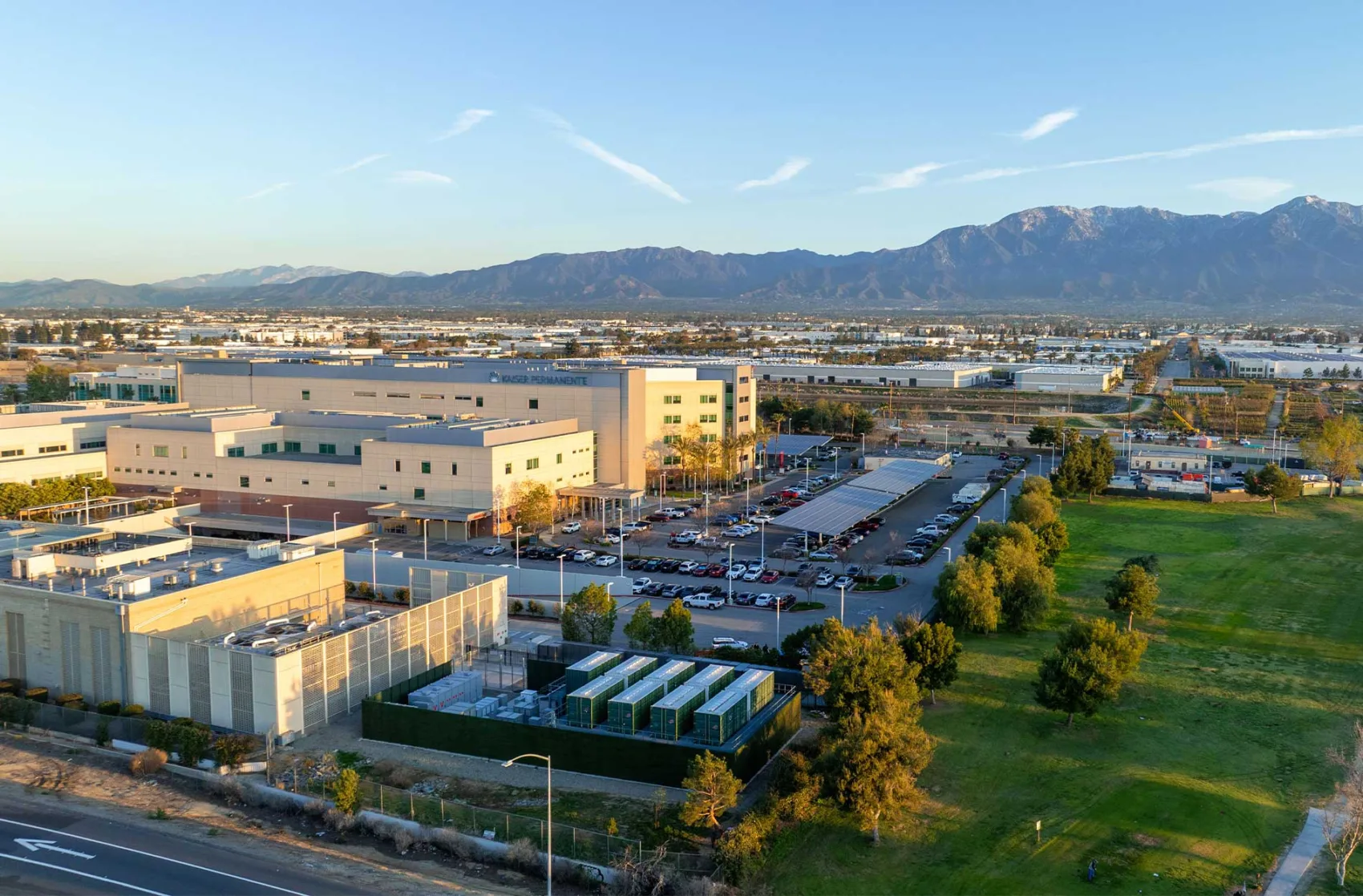
The most tangible example of Mazzetti’s LDES work is the Kaiser Permanente Ontario microgrid. Mazzetti partnered with Faraday Microgrids (then called Charge Bliss) to design and build what was, at the time, the first microgrid in the country to connect renewable energy and battery storage to an existing diesel backup system in a live hospital. The California Energy Commission funded two Kaiser Permanente demonstration projects, one in Richmond in 2018 and one in Ontario in 2021, and Kaiser Ontario became a genuine proof of concept.
The result: a hospital capable of running without diesel for up to 10 hours or more, thanks to a diverse mix of power assets tied into the critical branch. That is not a simulation. That is a fully functioning hospital that can island off the grid and keep going.
That project mattered because it proved the concept in the hardest possible environment. Not a lab. Not a whitepaper. A real hospital, with real patients, real regulatory scrutiny, and real consequences if anything went wrong.
Building the Strategic Case: Valley Children’s Health
Not every health system is ready to break ground on a microgrid next quarter. Many need to start upstream, understanding what they have, what they need, and what a realistic path forward looks like before any hardware gets specified.
That is the work Mazzetti did for Valley Children’s Health in Madera County, CA. VCH was facing two pressures at once: aging infrastructure and worsening wildfire risk were making reliable service harder to guarantee, while campus growth meant they needed an energy strategy that could scale with them, not just solve today’s problem.
Mazzetti developed a Strategic Energy Master Plan that addressed both. Starting with interval data analysis to understand actual peak load and demand patterns, the team right-sized a microgrid built around solar PV, batteries, and fuel cells. The same data informed energy benchmarking and reduction targets that would carry into future audits and central plant upgrades. It is the kind of integrated approach that turns a one-off project into a long-term asset.
Writing the Rules: Code Work That Opens Doors for Everyone
One of the less visible but most important things Mazzetti has done in this space is help change the codes that govern what is even allowed.
Historically, NFPA 99, NFPA 110, and NFPA 70 (the National Electrical Code) simply were not written with microgrids or battery storage in mind. Navigating the intersection of those standards, and convincing authorities having jurisdiction that a battery-based system is code-compliant for both normal and emergency power, has been one of the biggest barriers to LDES adoption in healthcare.
Mazzetti engineers have been in those code development rooms, writing the specific language that now permits microgrids in healthcare facilities. That work does not just benefit Mazzetti’s clients. It opens the door for the whole industry. It means that when a Mazzetti team is sitting across from a building official or a healthcare facilities manager asking about regulatory compliance, they’re not guessing. They helped write what is being cited.
The Bigger Picture: This Is Also an Equity Issue
There’s a version of the LDES conversation that stays comfortably in the realm of operational resilience and carbon metrics. That version matters, but it doesn’t tell the whole story.
Mazzetti became a Benefit Corporation because we believe engineering carries a responsibility that goes beyond the project at hand. Our mission, Bending the Climate Curve™, is about using what we know and what we’re good at to reduce building-related emissions and create healthier, more enduring environments. Not just for clients who can afford the best solutions, but for the communities that need them most and have the least power to demand them.
That’s where LDES and equity meet in a way that’s hard to ignore. Disadvantaged communities get hit harder by power outages. They have fewer resources to weather them, housing that’s harder to keep cool or warm, and a higher concentration of residents who depend on electricity to manage medical conditions. When the grid goes down in those neighborhoods, it is not an inconvenience. It is a crisis, and it lands on people who were already carrying more than their share.
The CEC’s EPIC program funded Mazzetti’s LDES demonstration work with exactly that in mind. Proving that clean resilience isn’t only for well-resourced health systems, that higher uptime, better air quality, and lower energy costs can reach the people who need them most; that is not a side benefit of this work. It is the point.
Bending the climate curve means something different when you are building it for the communities the curve has already hurt the most.
What This Means for Your Health System
If any of the following sound familiar, this is worth a conversation:
- You have been through PSPS events and want something better than topping off diesel tanks and hoping for the best.
- You are under pressure to reduce your carbon footprint without compromising 24/7 reliability.
- Your campus is growing, and you need an energy strategy that can scale with it.
- You want a clear-eyed look at what LDES costs and what it can earn back through demand response, peak shaving, and grid services.
- You are not sure how NFPA or interconnection requirements apply to your specific situation.
Mazzetti has done this work. We have designed the systems, written the code language, won the grants, and built the proof-of-concept projects. We know where complexity is, and we know how to get through it.

Long Duration Energy Storage Summit
Real projects, candid economics, and the codes that govern them.
The Long Duration Energy Storage Summit brought together industry leaders, innovators, and end users to explore emerging energy storage technologies, grid resilience, decarbonization strategies, and the future of energy infrastructure. Access session recordings, expert presentations, and panel discussions from this one-day event.
For more on Mazzetti’s energy resilience work for healthcare, reach out

"*" indicates required fields
Subscribe
"*" indicates required fields